
|
Tutorials | |
| by Bioinformatics Unit - CNIO || Terms of use || | [HOME] - [Documents] |


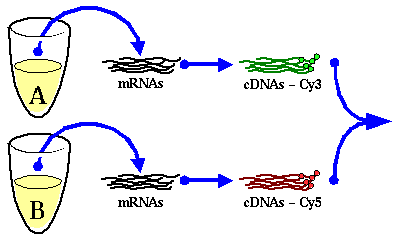
Fig. 1.1.1 mRNA is extracted from two different samples and labeled with a fluorescent probe. Both samples are mixed before hybridization.
A
B
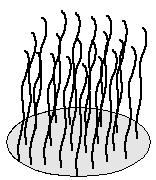
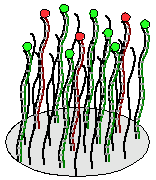
Fig. 1.1.2 (A) Spot before hybridisation: The cDNA's are spotted on the slide. (B) Spot after hybridisation: The labelled mRNA's are hybridized to the cDNA. The relative amount of the fluorescent probes depend relative amount of mRNA in the original samples,.
A
B
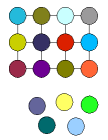
Fig. 1.2.1 Different representation of gene expression patterns (A) Normal plot (B) Gene expression pattern in a colorscale.
A
B
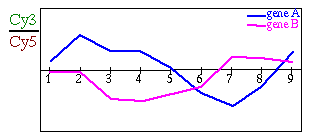
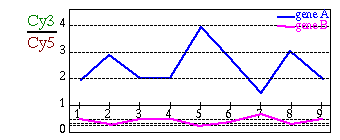
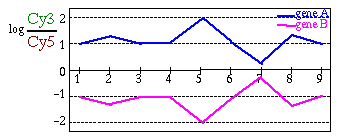
Fig. 1.3.1 Gene expression pattern: (A) Gene expression patterns before log-transformation: gene B seems to be nearly flat. (B) Gene expression patterns after log-transformation: it is now possible to see that gene A and gene B are symmetrical.
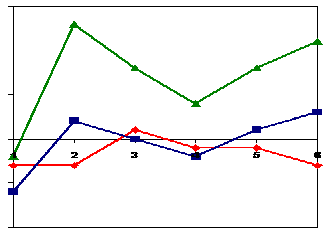
Fig. 1.4.1 This picture shows the different results we can obtain using the different types of distances. Using an euclidean distance, blue and red patterns will be clustered with preference to the green one, on the basis of their lower absolute differences. Using a correlation, blue and green patterns will be preferentially clustered because of their similar trends.
A
B
C
D
Fig. 1.5.1 UPGMA: the all-to-all distance matrix (black box) is calculated and two closest elements (red box) are merged. (A) The two closest elements are genes B and C. (B) The genes B and C are merged and the all-to-all distance matrix is calculated again using the new cluster instead of the genes B and C. Now, the two closest elements are genes A and D. (C) The genes A and D are also merged. The elements must be reordered to fit the topology of the tree. The all-to-all distance matrix is calculated again with the two remaining elements. (D) The process ends when all the complete dendogram is built.
A
B
C
D
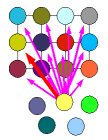
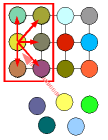
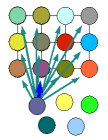
Fig. 1.6.1 Schematic representation of the working of SOM network (A) The lattice has random values at the beginning. (B) The first element is compared with all the nodes of the lattice to get the closest node (red arrow). (C) The winning node and its neighbourhood are updated. (D) Next item is compared with all the nodes of the lattice as in (B). This process is repeated thousands of times for all the items. .
A
B
C
D
E
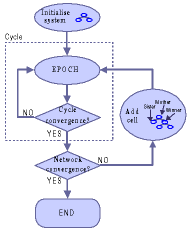
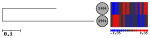
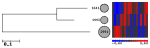
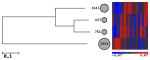
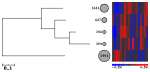
Fig. 1.8.1 (A) Schematic representation of the growing algorithm of SOTA network The neurons that compose the network are represented as vectors (rows of the data matrix) whose components correspond to the columns of the data matrix, that is, to the experiments at which each gene expression values have been measured. On the top, the Initial state of the network, with two terminal neurons, called cells, connected by an internal neuron called node. Cycle: repeat as many epochs as necessary to reach convergence (the error falls below a given threshold) in the present topology of the network. When a cycle finishes, the network size increases: two new neurons are attached to the neuron with higher resources. This neuron becomes mother neuron and does not receive direct inputs any more. Once the variability of all the neurons is below a given threshold the network growing ends. (B), (C), (D) and (E) Step-by-step growing of SOTA: the size of circles represents the amount of gene in the cluster and pattern of the cluster is drawn in a colorscale from blue to red.
| Send comments. Last rev. Friday 17 January 2003 |